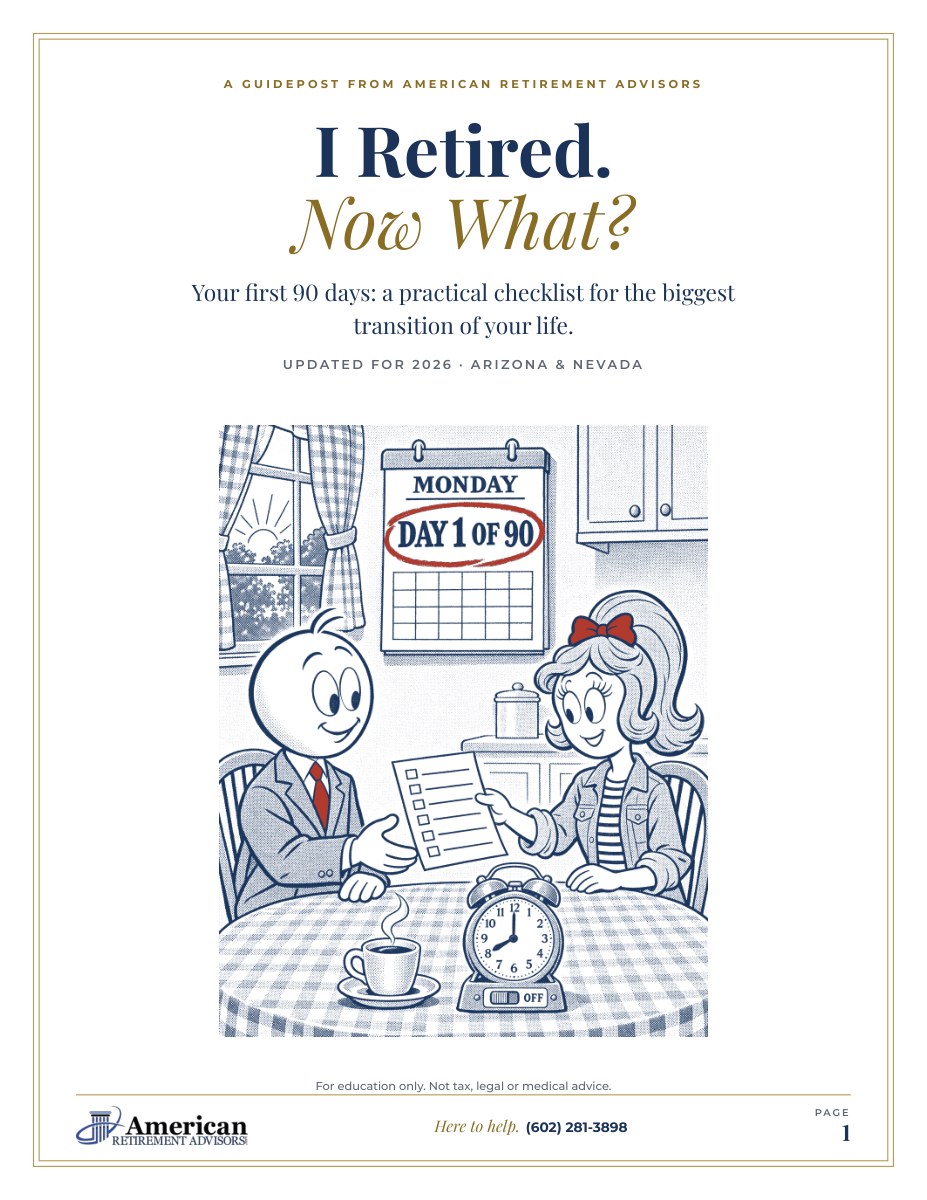
I Retired... Now What?
A practical guide for the biggest transition of your life.
The Party's Over. Now What?
You just retired. Congratulations. But now what? This guide walks you through the practical, financial, and emotional sides of your first 90 days.
Written by advisors who sit across from people in your exact situation every single week. Some are excited. Some are terrified. Most are both.
- Do you actually have enough money? (You probably do)
- The health insurance bridge and the COBRA trap after 65
- The emotional side nobody warns you about
- A printable 90-day checklist with purpose built in
- What the happiest retirees have in common
What's Inside This Guide
You Probably Have Enough Money
Most people overestimate what they need to retire. We'll show you how to check where you actually stand with a simple 3-step exercise.
The Health Insurance Bridge
COBRA after 65 is not creditable coverage. Miss the Medicare window and you pay a permanent penalty. We explain the 60-90 day rule.
The Emotional Transition
Boredom is not the real problem. Identity, purpose, and relationships shift when you stop working. Here's what helps.
The 90-Day Checklist
A printable checklist covering finances, health insurance, taxes, AND purpose. Practical items plus fun ones like "adventure day."
Download the Full Guide
The complete First 90 Days guide with checklists, planning strategies, and the emotional stuff nobody talks about. No email required.
12 pages. Takes about 10 minutes to read.
Quick Answers
What should I do in my first 90 days of retirement?
Start with health coverage. If you're 65 or older, you have 8 months after your job or its coverage ends, whichever is first, to sign up for Part B without a penalty, and COBRA doesn't stretch that. Under 65, compare a spouse's plan, COBRA and a Marketplace plan. Then set up income deposits and move a 401(k) by direct rollover.
Key facts
- At 65 or older, you can sign up for Part B without a penalty up to 8 months after your job or job-based coverage ends, whichever comes first. Source: Medicare.gov
- COBRA and retiree coverage don't count as job coverage for that window, and a late Part B signup adds 10% to the premium for each full 12 months you could have had it. Source: Medicare.gov
- Under 65, COBRA generally lasts up to 18 months at up to 102% of the premium, and losing job-based coverage opens a 60-day window to enroll in a Marketplace plan. Source: 29 U.S.C. 1162
- If a 401(k) pays you directly, 20% is withheld for income tax and you have 60 days to roll it over. A direct rollover avoids the mandatory withholding. Source: IRS
- Arizona doesn't tax Social Security benefits, and Nevada has no personal income tax. Source: Arizona Legislature
First 90 Days Questions, Answered
I'm retiring after 65. When do I sign up for Medicare Part B?
You can sign up without a penalty while you or your spouse are still working, or within 8 months after the job or the job-based coverage ends, whichever comes first. Signing up before that coverage ends helps avoid a gap. COBRA and retiree coverage don't extend the window. Miss it and Part B costs 10% more for each full 12 months you could have had it, for as long as you have Part B.
I'm retiring before 65. How do I keep health insurance?
There are three common bridges. A spouse's employer plan is often simplest, and losing your own coverage lets you join it outside its usual enrollment period. COBRA keeps your current plan, generally for up to 18 months, but you pay up to 102% of the full premium. A Marketplace plan opens a 60-day window when job-based coverage ends, and many households qualify for premium tax credits.
What should I do with my 401(k) when I retire?
If you move it, ask for a direct rollover, where the plan sends the money straight to an IRA or your new plan. If the plan pays you instead, it must withhold 20% for federal income tax, and you have 60 days to roll the money over or it counts as income. To roll over the full amount, you would have to make up the withheld 20% from other money.
What taxes surprise people in their first year of retirement?
Your last working year can be one of your highest-income years once severance and vacation payouts are added, and that income can raise Medicare premiums two years later through IRMAA. Up to 85% of Social Security benefits can be taxable. Required minimum distributions start at 73, or 75 if you were born in 1960 or later. Arizona doesn't tax Social Security benefits, and Nevada has no personal income tax.
What belongs on a first-90-days retirement checklist?
Confirm health coverage with no gap, your final paycheck and any severance or vacation payout, and your Social Security and pension deposits. Compare your steady income, such as Social Security and pensions, with the last 12 months of actual spending. Check beneficiary designations, your will, power of attorney and health care directive. Estimate your first-year taxes and withholding. Then give yourself a weekly routine; structure helps.
Sources
- Medicare.gov: When does Medicare coverage start?
- Medicare.gov: Avoid late enrollment penalties
- 29 U.S.C. 1162: COBRA continuation coverage
- HealthCare.gov: Special Enrollment Period
- IRS Topic 413: Rollovers from retirement plans
General education, not tax, legal or insurance advice. Medicare and tax rules change each year.
The full guide goes deeper. Get the guide above.
Keep going
More for your first years of retirement
 Leaving Your Employer's PlanWorking past 65? When you can wait on Part B, the 8-month window, and the forms to send.
 Is Your Social Security Right?How to check your Social Security earnings record and fix mistakes before they cost you.
- Listen The Gap Years, a podcast series
- How we help Retirement income planning