Health Care Sharing Ministries
What they are, what they aren't, and where they fit in the years before Medicare. Updated for 2026 for Arizona and Nevada. An educational overview, not an endorsement.
Sharing Medical Bills in the Years Before Medicare
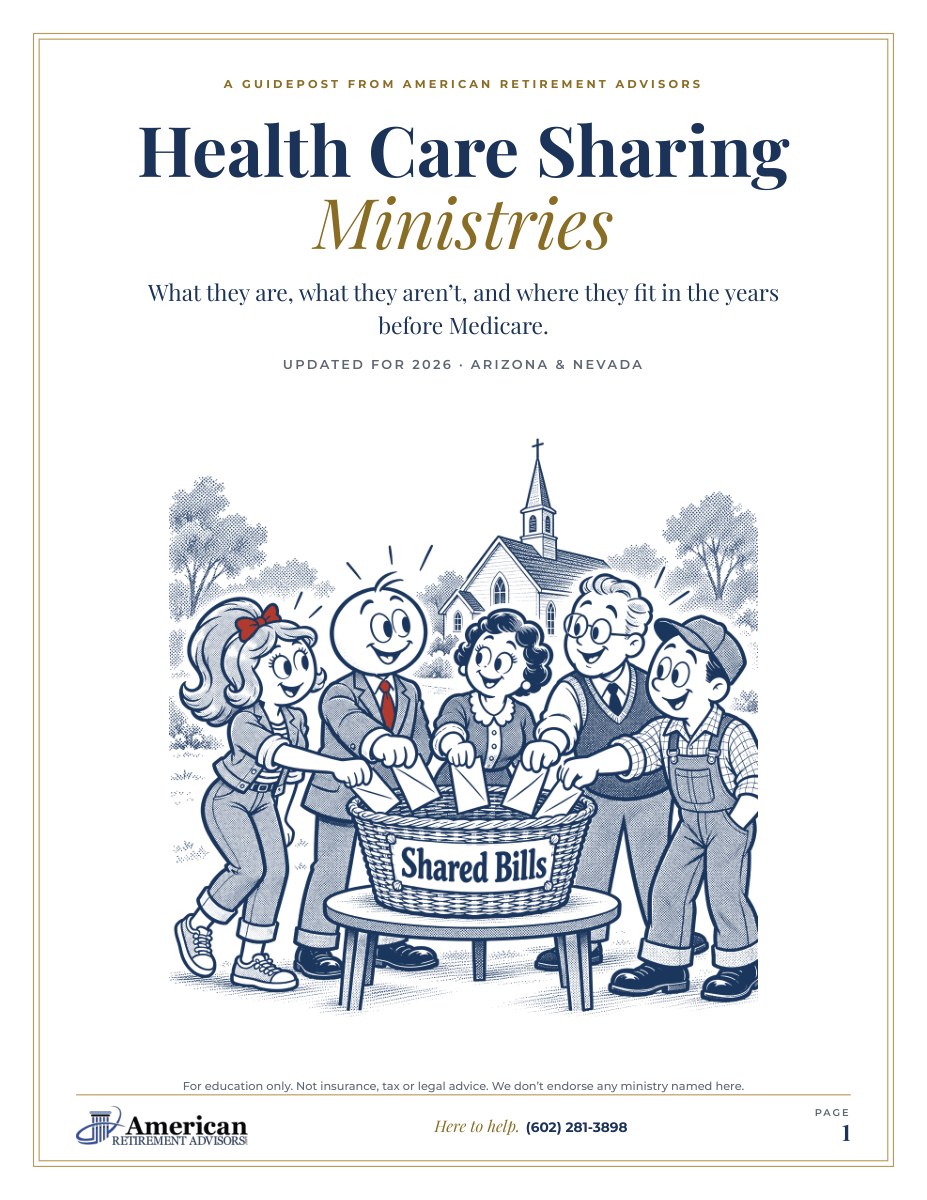
Retire before 65 and you leave your employer's health plan years before Medicare starts. Health care sharing ministries come up often in that conversation. Members who share religious or ethical beliefs pay a monthly share and help pay one another's medical bills. They usually cost less each month than insurance. They are also not insurance, and nothing promises that any bill will be paid.
We do not endorse or sell any of these programs. This guide compares sharing with a Marketplace plan, walks through the other ways to bridge the years to 65, and explains why a sharing ministry does not replace Medicare.
- What a health care sharing ministry is, how sharing works, and why it is not insurance
- Sharing next to a Marketplace plan: pre-existing conditions, limits, and the most you could owe
- Other ways to bridge the years before Medicare, from a spouse's plan to COBRA
- Why a sharing ministry does not replace Medicare at 65, and the late-enrollment penalties to avoid
- How to check out a ministry before you join, the ones you'll hear about, and what to ask
What You'll Learn
What a Sharing Ministry Is
Members who share religious or ethical beliefs pay a monthly share and help pay one another's bills. How it works, step by step, and what the federal definition requires.
Sharing Versus Insurance
Sharing and a Marketplace plan side by side: the promise to pay, pre-existing conditions, limits, your maximum cost, and who oversees each.
Bridging to 65, Then Medicare
A spouse's plan, COBRA, retiree coverage and the Marketplace, compared. Plus why sharing doesn't count for Medicare, and how to avoid the late-enrollment penalties.
Before You Sign Up
How the IRS treats monthly shares, how to check out a ministry, the ones you'll hear about with websites and phone numbers, and the questions to ask before you join.
Get the Full Guide
The complete 2026 edition: what sharing ministries are, how they compare with insurance, how to bridge the years before Medicare, and what to ask before you join. No email required. No strings attached.
10 pages. Takes about 10 minutes to read.
Quick Answers
What is a health care sharing ministry?
A health care sharing ministry is a nonprofit whose members share religious or ethical beliefs, pay a monthly share and help pay one another's medical bills. It is not insurance, and nothing promises that a bill will be paid. Arizona law says so. A ministry also does not count as coverage that lets you delay Medicare without a penalty.
Key facts
- Arizona law (A.R.S. 20-122) says a sharing ministry's practices are not insurance, and applicants must be told they are always personally responsible for their own medical bills. Source: Arizona Legislature
- The federal penalty for going without health insurance has been $0 since 2019. Source: IRS
- Signing up for Part B late adds 10% to the premium for each full 12 months you could have had it, for as long as you have Part B. The standard premium is $202.90 a month in 2026. Source: Medicare.gov
- The Part D late penalty is 1% of the national base premium ($38.99 in 2026) for each month without creditable drug coverage, added for as long as you have Medicare drug coverage. Source: Medicare.gov
- Marketplace open enrollment for 2027 runs November 1, 2026 to January 15, 2027. On HealthCare.gov, enroll by December 15 for coverage that starts January 1. Source: HealthCare.gov
Sharing Ministry Questions, Answered
Is a health care sharing ministry the same as health insurance?
No. A ministry has no contract to pay your bills, and sharing is voluntary. Arizona law says a qualifying ministry's practices are not insurance, and it must tell applicants they are always personally responsible for their own medical bills. In Nevada, the Division of Insurance has warned that sharing ministries don't comply with the Affordable Care Act, that many don't guarantee payment, and that members owe whatever the ministry doesn't pay.
How is a sharing ministry different from a Marketplace plan?
A Marketplace plan is a contract. It must cover pre-existing conditions without charging you more for them, it can't set yearly or lifetime dollar limits on essential health benefits, and it caps what you pay in a year ($10,600 for one person in 2026). A ministry promises none of that and typically restricts or excludes pre-existing conditions. Federal premium tax credits come only with Marketplace plans.
Can a sharing ministry bridge the years before Medicare?
For a healthy family that shares a ministry's beliefs, it can be one way through. Compare it with the other bridges first: a spouse's employer plan, COBRA (generally up to 18 months, at up to 102% of the full premium), retiree coverage from a former employer, or a Marketplace plan. Losing job-based coverage opens a 60-day window to enroll in a Marketplace plan outside open enrollment.
Does a sharing ministry count as coverage when I turn 65?
No. You can delay Part B without a penalty only while you have health coverage through your own or your spouse's current job, and a ministry doesn't count. Neither do COBRA, retiree coverage or a Marketplace plan. Sharing ministries also aren't on Medicare's list of creditable drug coverage, so waiting on Part D can bring a penalty. A Marketplace plan doesn't end on its own when Medicare starts, and its premium help stops once you're eligible for Part A.
Are ministry shares tax deductible, and can I use an HSA?
Not clearly. In 2020 the IRS proposed treating sharing ministry memberships as medical expenses, but it has not finalized that rule. To contribute to a Health Savings Account you need a qualifying high-deductible health plan, and a sharing ministry isn't one. Ask your tax professional before claiming any deduction for ministry shares.
Sources
- Arizona Revised Statutes 20-122: Health care sharing ministries
- Medicare.gov: Avoid late enrollment penalties
- Medicare.gov: Signing up for Part B when job coverage ends
- HealthCare.gov: Marketplace dates and deadlines
- Nevada Division of Insurance: consumer alert on sharing ministries
General education, not insurance, tax or legal advice. We do not endorse or sell any health care sharing ministry.
The full guide goes deeper. Get the guide above.
Keep going
More on Medicare and health costs
 Leaving Your Employer's PlanWorking past 65? When you can wait on Part B, the 8-month window, and the forms to send.
 Dental Care in RetirementWhat Medicare pays for, dental insurance versus discount plans, and lower-cost clinics in Arizona and Las Vegas.
- Listen Seven Ways In, a podcast series
- How we help Medicare planning
- Annual Enrollment Period Your plan letter came: what to do before December 7