Long-Term Care Insurance and Your Taxes
Long-term care insurance has its own tax breaks, and many people never use them because they don’t know they’re there. Which one is yours depends on how you earn your living.
Let the Tax Code Help Pay for Care
A long-term care insurance premium can lower your taxes, but not the way most people expect. Most households are stopped by two gates: medical costs count only above a share of your income, and only if you itemize.
There are routes around those gates. Business owners can deduct premiums without itemizing. People still working can pay with Health Savings Account dollars or have an employer pay. Retirees can benefit on the other end, when benefits are paid.
Where a rule isn’t settled, the guide says so plainly and shows what we found on the IRS’s own pages, so you can take it to your tax professional.
- The four gates a premium has to pass before it lowers your federal tax
- Business owners: the self-employed deduction, and how each type of business has to set it up
- Still working: employer-paid premiums, Health Savings Accounts, and a new retirement plan rule for premiums
- Retired: tax-free benefits, the care-year deduction, and what to know before exchanging an old annuity
- An after-tax worksheet for business owners and Health Savings Account households
- Arizona and Nevada notes, plus the questions to bring to your tax professional
Three Tracks, One Question: Which Break Is Yours?
The Four Gates
Why a premium often doesn’t lower your tax at all, and the three routes that skip the two hardest gates.
If You Work for Yourself
When your business shows a profit, you can deduct tax-qualified premiums without itemizing, for yourself and your spouse.
If You Still Draw a Paycheck
Who pays makes the difference: premiums your employer pays, Health Savings Account dollars, or your own after-tax money.
If You Are Retired
Benefits from a tax-qualified policy are generally tax-free, and in a year care is needed, care costs may be deductible if you itemize.
Choose Your Version
Both come from the same research, checked against IRS sources for tax year 2027. No email required. Download one, or both.
The One-Page Sheet
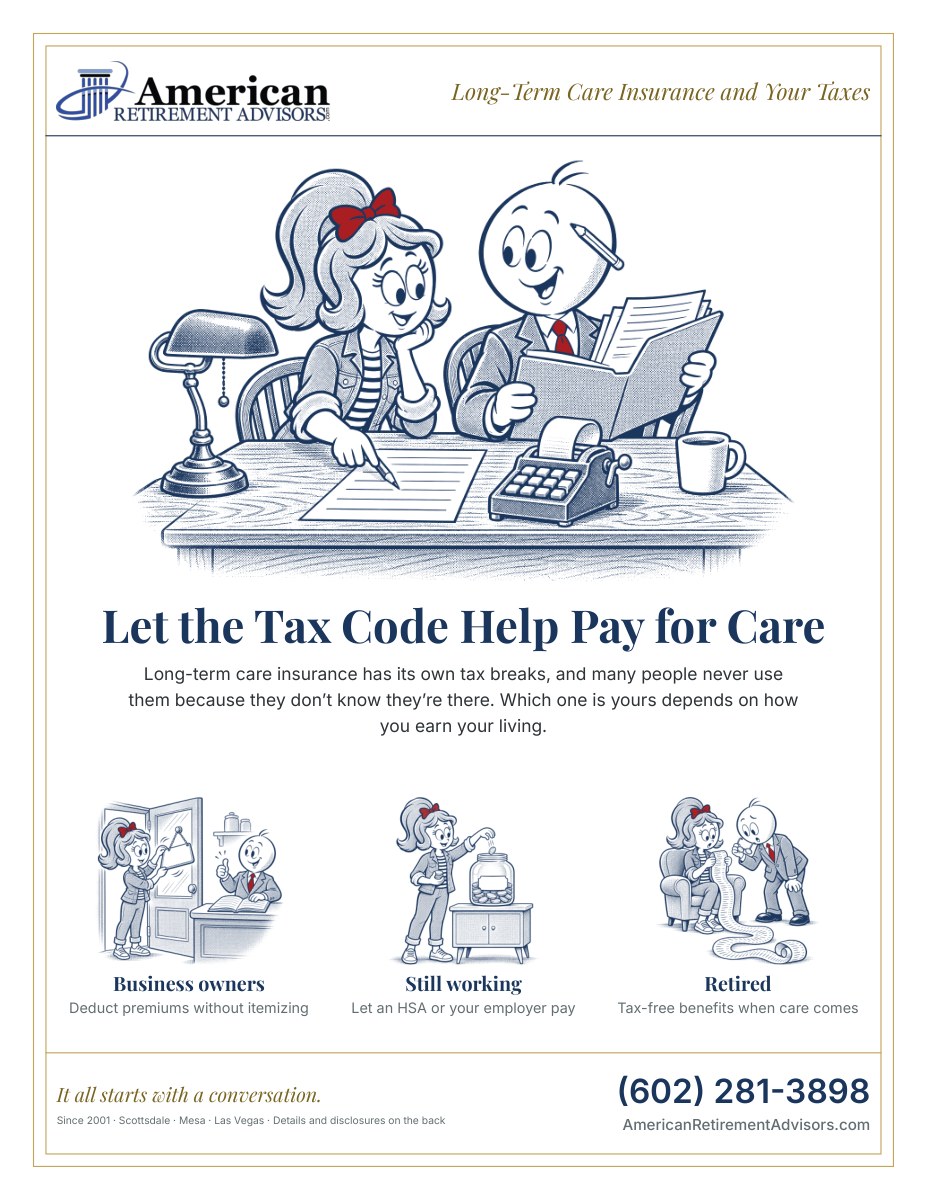
The short version: which tax break fits you, on the front and back of one page.
A 2-page PDF, front and back. About 3 minutes to read.
The Complete Guide
All three tracks, the worksheet, the gray areas, and the questions to bring to your tax professional.
A 27-page PDF. About 30 minutes to read.
Tax figures are 2027 federal amounts. Medicare figures in the complete guide are 2026 amounts, labeled as such, until the 2027 amounts are released.
For educational purposes only. Not tax, legal or investment advice; talk to your tax professional about your own situation. Long-term care insurance is subject to underwriting, waiting periods, limitations and exclusions. Premiums for traditional policies are not guaranteed and can increase. Not everyone qualifies, and products vary by state and insurance company.
Keep going
More on long-term care
 The Long-Term Care Planning GuideWhat long-term care costs in Arizona and Nevada, what Medicare won't pay, and the ways to plan.
 Long-Term Care PlanningA one-page look at what care costs, how to pay for it, and when benefits begin.
- Listen More Than a Death Benefit, a podcast series
- How we help Financial planning with healthcare built in