Financial Tip of the Month
Acing your 529 College Savings Account
Although avoiding mistakes regarding your 529 plan is desirable, it may be of comfort to know that you cannot make a catastrophic mistake when it comes to these accounts. With the state eager to remain competitive, fees are driven lower and lower, while there will also always be the option to roll this plan over into a different 529 plan. With that said, here are some tips to avoid common mistakes the first time around with your 529 college savings account. [spacer height="20px"] Contributing the wrong amount. The first potential mistake can arise when choosing how much to contribute to the account. Both issues of either contributing too much or too little can have repercussions of their own. College expenses are consistently on the rise, and the average American family cannot afford their child’s college degree outright. Due to this unfortunate reality, states have made sure to have a low minimum contribution payment for these accounts. However, if you are keeping college savings in a taxable savings account, opposed to the 529 plan account, you are certainly contributing too little to your 529 plan. On the flip side, contributing too much to your 529 plan can result in a 10% penalty tax when you withdraw this money. This can be viewed as a good problem, as you are still reaping the benefits of the liquid and tax advantaged 529 savings account; however, some may wish to avoid this these particular taxes altogether. [spacer height="20px"] Ignoring the fine print. Another common mistake is assuming that the money put into your 529 plan will be available for any expense related to college. Of the many costs that go into your beneficiary going off to college, not all of them are qualified expenses; for example, off-campus student living, transportation, or student loans. It is important to be informed of all restrictions and qualifications before deciding how much to contribute to your 529 college savings plan, and how much to leave out for the non-qualified expenses. [spacer height="20px"] Ignoring the gift tax exclusion. Many people also simply don’t know they can take advantage of gift tax exclusion by participating in a 529 college savings plan. According to federal law, 529 plans are considered gifts, and allows many contributors to avoid estate taxes. You can contribute up to $14,000 a year to your beneficiary’s 529 plan without incurring any federal state tax. [spacer height="20px"] Using this account as an emergency fund. Withdrawing money from your 529 saving account will result in a 10% penalty on top of being taxed on the earnings. Needless to say, it will also make saving a sizable amount for your beneficiary more difficult. [spacer height="20px"] Waiting to save. Another unfortunate mistake made by many families is starting a college savings account too late. You can start a 529 savings account before your child is even born, giving this type of account the potential to grow into a sizable nest egg for your child or other beneficiary to use for their education. It is never too early to start planning and saving for something that will be so valuable in the future. In the case that your child is born a star athlete and receives a full scholarship (which is notably rare), these accounts can be used for different beneficiaries or can even be used for yourself, thus, leaving no excuses to put off college savings for your loved ones! [spacer height="20px"] Follow this link for the full version of the July newsletter: https://americanretirementadvisors.com/wp-content/uploads/2015/07/2015-July-Newsletter-www-americanretirementadvisor-com-Final.pdf

American Retirement Advisors Earns A+ Rating from the BBB
American Retirement Advisors is honored to receive an A+ rating from the Better Business Bureau in regards to our exceptional customer service, ethical business practices, and conducting business with full integrity. This respected accreditation is important to American Retirement Advisors because we continuously strive to develop and build strong relationships with our clients based on transparency and trust. Our hope is that this highest accreditation from the BBB will solidify this for those who are unfamiliar with our practices. [spacer height="20px"] Factors that earned American Retirement Advisors the A+ rating include advertising honestly, remaining transparent with clients, and consistently honoring promises and acting in good faith. It is also based on being responsive to clients in a timely manner, along with the protection of all data collected by the company. [spacer height="20px"] This A+ rating is among several milestones and recognitions that have been accomplished by the company this year. We continue to strive to provide consistent and quality services for our clients and are thrilled to possess this A+ rating in order to acknowledge it. [spacer height="20px"] 
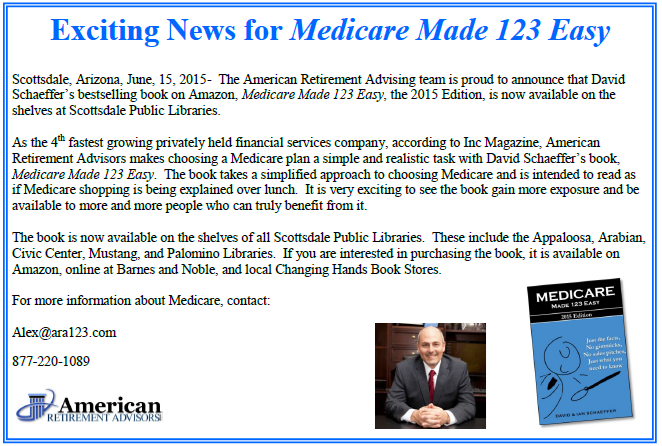
Medicare Made 123 Easy – Now Available at Scottsdale Public Libraries!
Things to consider when choosing a Medicare plan
[spacer height="5px"]How Am I Supposed to Pick a Medicare Plan?
This task can be daunting, especially if you live in a large metropolitan area like say…Phoenix, AZ. In that metro area there are 48 carriers of Medigap plans, each offering as many as 10 plans, 30 Prescription Drug Plans, and 39 Medicare Advantage plans. The mixture means there is a possibility of more than 14,439 combinations that you, as a Medicare consumer, can choose. Unless you have the tools to discover every plan in your area, you may find selecting an appropriate plan an almost impossible task to perform by yourself. “Would you go into a hospital emergency room and just ask for an X-Ray, some anesthetic, and a scalpel so that you could operate on yourself? Heck no! You’d want the best doctor or surgeon on duty to fix you. Then why on earth would you try to attempt to pick a Medicare plan without the assistance of a local expert?” Choosing a plan that is most appropriate for you includes other considerations as well. Do you want a plan with no co-pays or deductibles? How can you tell if your physician is on a network plan that you are considering (no, you can’t call the doctor’s office because they don’t know either, nor are they responsible to give you an accurate answer). So, how do you find out? If you call to talk to the sales department from one of the carriers and they send an agent to your home, they are probably a one-trick pony. They have one product to sell you for Medicare health coverage! But by golly it will be the next best thing to sliced bread! How do I pick a Medicare plan? If you had the choice, would you rather deal with an Advisor who can share offerings from all the Medicare plans?Healthcare Decision Making Is Up Side Down!
American Retirement Advisors Turns Healthcare Decision Making Right Side Up!
By David S. Edge and David P. Schaeffer, American Retirement Advisors When choosing healthcare most folks choose a brand they are familiar with from their previous employment or personal experience from prior years. You have become “Brand Loyal” because the plan you had worked for you and you were satisfied. You liked your doctor, labs and specialist and the co-pays for Drugs weren’t all that expensive. Now you have to pick a Healthcare plan to start over and where do most shoppers go? To the Brand they know! So you pick a Brand you’re familiar with, a Plan, Network, and hope they have good Physician and prescription co-pays. What you’re selecting based on this process is “I hope so” healthcare when it should be “I Know So” healthcare. Instead of having a warm fuzzy for a brand you’ve used in the past, what you need to be doing is hard research for a “Fact Based Decision”. Most Employer plans are a version of what a Brand has to offer based on what the employer wants to pay for employee healthcare. This is why two employer plans can have the same name brand but the plans co-pays will be much different.
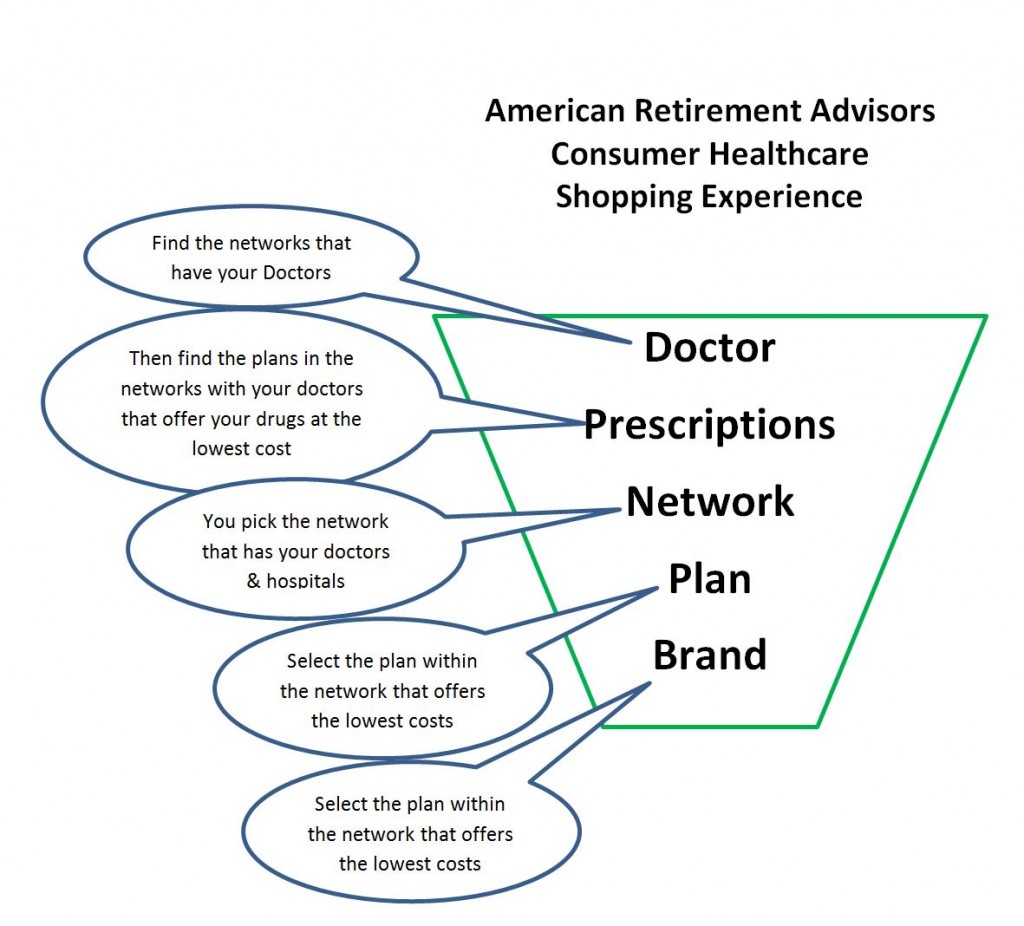 By using the American Retirement Advisors method you start your search with your Doctor’s and Hospital you want to keep and use. Then as you narrow your search to the handful of networks and plans your Doctor and Hospital are participating with, lay in your prescription drug needs and discover exactly what your co-pays will be on those plans. As you narrow your choices to a plan then look for the “Brand” of that specific plan. As you narrow your search from dozens of plans to the 2 or 3 that have your Doctor, Hospital and Drugs on their formulary, you’ll have other things to consider. Many times these items to consider will be costs associated with co-pays and deductibles on Doctor and Specialist visits, labs, diagnostics, X-Rays, and other medical services. These costs should also include a monthly premium if any, and a Maximum out of pocket dollar amount which would be the maximum total of co-pays you would be responsible for paying in an entire calendar year.
Long-Term Care
Medicare and Long-Term Care? What is it and What’s covered?
The high cost of long-term care is what most folks are concerned about. When discussing this with clients, the one thing we ask is “What’s your Plan?” Many people take this as what long- term care policy do you have in place when I mean nothing of the sort. I asked “what’s your plan?” Your plan can be that you are going to have a relative come to your home and take care of you and there will be some sort of financial compensation. Or maybe it’s an adult child or someone else who loves you dearly that’s going to take care of you. The point is, you have a plan that doesn’t necessarily involve having an insurance policy. Many folks are concerned about their quality of life if they should become disabled or have a long-term health issue. What we need is to review what’s covered under your current Medicare coverage first. Medicare is “medical coverage” not “long-term care” coverage. What does that mean? As long as you are in the hospital or a Skilled Nursing Facility recovering from an accident or rehabilitation from surgery, you will be covered by your Medicare coverage as long as you spent three days in the hospital first. This can be through Medicare with a Medigap (Medicare Supplement) policy or a Medicare Advantage plan. The key to this coverage is that you are improving or being rehabilitated and showing improvement from an illness, accident, or surgery. This type of Skilled Nursing coverage is usually good for 1-100 days per event. Your co-pay, if any, will differ depending on which Medicare plan you have. An example would be a Medicare Medigap Plan F would have no co-pay for Skilled Nursing during the first 100 days, where a Medicare Advantage Plan may have no co-pay for the first 10-20 days but co-pays after day 21 to 100. Remember these are just examples of coverage. Your coverage and co-pays are outlined in your Summer of Benefits with your policy. If you are suffering from a cognitive or physical limitation that shows no improvement and just need daily ongoing “custodial care”, this is when you need “long-term care”. This is not covered by Medicare and Medigap or Medicare Advantage. Long-term care situations can be anything from mental or physical conditions which are judged on 2 of the 6 ADLs (Activities of Daily Living), or cognitively impaired. In other words, you can’t perform daily functions without assistance. This can also include a variety of illnesses where you require constant medical supervision such as stroke, or some other debilitating condition. We suggest you do your research before any of this happens. Discuss your concerns with a Retirement Planner you trust. Hint, Hint, we know someone who can help and their name starts with a “D”!! JPrescription Drug Discounts Memberships
Hey! Look what came in the mail!! It’s A Prescription Drug Discount Membership!
I get at least a call a week from our wonderful clients alerting me to the unbelievable discount prescription card program that came in the mail! And wanting to know if it’s for real? Well…..I don’t want to bust anyone’s bubble here but most of these programs are merely marketing ploys to get your personal information so that they can send you more discount programs for grocery stores, oil change coupons, discount home air conditioner check-up, etc. There’s lots of cool stuff where you get it for “free” and just pay shipping and handling (S&H is usually more than what the item would cost to purchase). Folks, don’t get suckered into giving away your personal information. If you think you’re getting junk mail now? Well, just watch it grow after you’ve signed up for your Prescription Drug Discount program. Another thing, read the small print! It’s fascinating stuff!! There’s more legal mumbo jumbo than you can shake a stick at!! Most of it protecting the marketing company from you taking legal action against them! If you really want a deal …..shop prices! Go to the manufacturer’s website and download coupons directly from them. Remember the old adage, if it sounds too good to be true……..Kenneth Sherman – Southwest Art
You’re Invited!!!
Come and experience the creative art of Kenneth Sherman!
You will enjoy the various ways he expresses his art through acrylic, watercolor, and sculpture.
Wednesday Feburary25th 2015 at 5:30 PM
at our offices located at 14861 N. Scottsdale Road, Suite 101.
The evening will be filled with art, friends, wine and cheese.
All are welcome, please bring friends.
Each attendee will receive a complementary limited edition gallery print signed by the artist.
Please RSVP by calling 602-281-3898 or email Judi@americanretire.com